What are the roles of coagulants and flocculants? 【Basic Knowledge】
Do negative particles gather with positive force? What is the mechanism of coagulants and aggregants?
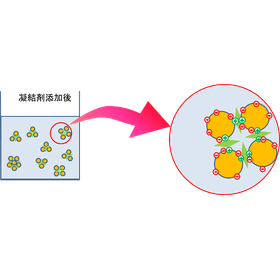
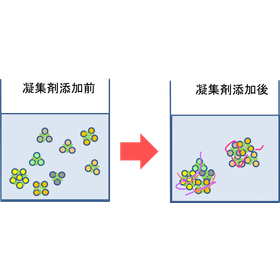
■ What is a coagulant? A coagulant is a cationic polymer with a relatively low molecular weight. In water, negatively charged colloidal particles float while repelling each other, but the positive action of the coagulant cancels out this repulsive force, allowing intermolecular forces (Van der Waals forces) to create small aggregates (microflocs). ■ What does a flocculant do? A flocculant is a chemical used to aggregate substances dispersed in water. The colloidal particles contained in raw water can be removed more easily by using filtration or sedimentation, as the small flocs created by the coagulant are further gathered by the flocculant into larger sizes. ■ How do the two chemicals work together? The coagulant neutralizes the charges of the repelling colloidal particles to form small flocs, while the flocculant, which is a chain-like polymer, entangles these flocs together, allowing them to grow into larger clumps. The negative charges are neutralized by the positive forces, and they are connected like strings to increase in size. Please feel free to consult us first.
- Company:トリイ
- Price:Other